
Quick answer: For most market and competitive intelligence work, no, not on its own. Microsoft 365 Copilot is built to reason over content already inside your Microsoft 365 tenant, your files, mail, chats and meetings, under each user's existing permissions. That makes it strong on questions whose answer is already written down in your organization. Competitive intelligence usually is not: the answer sits in licensed analyst research, subscription news, filings and scientific literature outside your tenant. Connectors now reach further than most people realize, and several research publishers can be queried live from inside Copilot. But that requires the paid add-on, your own subscription to each publisher, and per-source setup, and it still leaves you assembling an intelligence capability rather than buying one.
Key takeaways
- Copilot's strength is your tenant: files, mail, chat and meetings, and only content the user can already open.
- Its weakness is the outside world. Your competitors' moves are not in your SharePoint, and Copilot's web grounding is a short Bing lookup, not research.
- Licensed research is not included, but connectors reach further than most people think. Several publishers now query live inside Copilot, if you have the paid add-on and your own subscription to each one. Microsoft says license compliance is yours.
- Custom agents move the work, not the problem. Copilot Studio's public-web knowledge is a scoped Bing search, so nothing behind a paywall or login is reachable.
- Copilot answers when asked. It is not a monitoring system, and the competitive signal you did not think to ask about is the one that costs you.
- It is a real cost. $30 per user per month on top of a qualifying Microsoft 365 plan, and external connector grounding requires that paid license.
What does Microsoft 365 Copilot actually read when it answers?
Copilot's usefulness is entirely a function of what it can see, so settle this first. Microsoft 365 Copilot (the paid add-on) grounds answers in your organizational content through Microsoft Graph, generating responses "anchored in your organizational data, such as user documents, emails, calendar, chats, meetings, and contacts." It inherits your access model rather than replacing it: Copilot "only surfaces organizational data to which individual users have at least view permissions." If a user cannot open a document today, Copilot will not summarize it for them tomorrow.
It can also reach the public web, far more narrowly than most people assume. When web grounding is enabled Copilot may query Bing, and what leaves your tenant is "a few words informed by the user's prompt," not the full prompt and not your files. Administrators can switch it off entirely. So Copilot's view of the internet is a short keyword lookup you do not control, not a research pass over sources you chose.
One tiering detail matters when comparing plans: Microsoft states that the Basic tiers "don't have access to Microsoft Graph." Grounding in your own content is a function of the paid license, not something every Microsoft 365 seat already has.
Where does Copilot fall short for competitive intelligence?
The gaps are not the ones people expect. Copilot is not a general chatbot guessing from training data, so the usual complaints about consumer AI tools mostly do not land. Its limits here follow from its design.
Your competitors' moves are not in your SharePoint
This is the whole argument in one line. Copilot is architected around the premise that the answer already exists in your organization's records. Competitive intelligence inverts that premise. What a rival priced last week, which trial a competitor advanced, what a regulator published on Friday: none of it was ever written down inside your tenant. Copilot can tell you what your team said about a competitor. It cannot tell you what the competitor did.
Licensed research is not included, and the license is your problem
Most decision-grade market intelligence sits behind a subscription: analyst research, industry databases, trade press, scientific literature, financial data. A Copilot license entitles you to none of it. Publishers have started closing that gap themselves, and the progress is real. Forrester ships both a Copilot connector and an AI agent that surfaces its research inside Copilot, for customers with an active Forrester license, and connectors exist for IDC, Statista, S&P Global, PitchBook and PubMed among others. Coverage is uneven, though: there is no Gartner connector in either of Microsoft's connector galleries.
So you bring the subscription, each publisher decides what to expose, and each source is configured separately. Microsoft's terms of use put the obligation on you, requiring compliance "with any third-party rights, licenses, and obligations" and stating that "Microsoft isn't a party to your agreement(s) with third parties." If your licenses restrict where material can be copied or indexed, that is a question for legal, not a setting in the admin center. More on why most enterprise AI tools cannot legally read the content you need.
Citations are promised "where possible"
Copilot does cite. Microsoft's transparency documentation says that "where possible," responses based on business documents "include references to the sources for users to verify the response and learn more." That hedge is doing real work, and Microsoft is direct about why: the same document warns Copilot "may include information in its response that isn't present in its input sources" and asks readers to "be aware of the risk of overreliance." For a brief a VP will interrogate, the gap between usually cited and traceable at the claim level is the gap between an answer you can defend and one you re-verify by hand.
Verification time is a measured cost, not a theoretical one
The Australian government ran one of the larger public-sector Copilot evaluations available, covering over 5,765 licenses, with more than 50 agencies contributing to the evaluation. Results were broadly positive on speed, but evaluators found Copilot's "potential unpredictability and lack of contextual knowledge required time spent on output verification and editing which negated some of the efficiency savings." More pointedly for anyone circulating AI-assisted analysis, "61% of managers in the pulse survey could not confidently identify Copilot outputs." That trial ran in 2024 and the agency commissioned its own evaluation, so treat it as directional rather than independent.
Can Copilot connectors bring in licensed and external research?
More than most people realize, and an assessment written a year ago would get this wrong. There are two mechanisms. Synced connectors index external content into Microsoft Graph so it behaves like tenant content. Federated connectors, newer, query an external system in real time using the Model Context Protocol, with nothing indexed into Microsoft 365. Several research publishers ship federated connectors, so a Copilot user with the right subscriptions can query them live rather than against a stale index. Credit where it is due: that is a real capability, and a recent one.
Three things decide whether it adds up to an intelligence function.
You pay twice, and the licensing boundary is not where you would guess. Microsoft publishes a table showing any Microsoft 365 plan can index connector content into Microsoft Search, but grounding Copilot on that content requires the Copilot add-on. Federated connectors are "available only to tenants and users with a Microsoft 365 Copilot add-on license (or Microsoft 365 E7)" and "aren't supported with Copilot Studio licenses or Microsoft 365 Copilot pay-as-you-go." Search and Copilot grounding are licensed separately, which surprises people mid-project. On top of that you bring, and pay for, every publisher subscription yourself.
Coverage is uneven and the assembly is yours. Each publisher decides what to expose, each source is enabled and maintained separately, and the gaps turn up where you find them rather than where you planned for them. Microsoft's terms of use put the license obligation on you, and citations over connector content are links to the returned item rather than to the passage a claim came from.
Indexing your own external systems has documented limits. If you index a repository yourself as a synced connector rather than using a publisher's federated one, schema properties must be labeled correctly for content to surface in Copilot at all, and Microsoft is candid that its semantic index suits topical questions over text-rich items. It lists what does not benefit: "queries without topics or keywords," "queries with multiple parameters," and "queries requesting counts of items." A known-issues page adds that "prompts to get a list of items based on custom metadata aren't supported." Microsoft's own example is a helpdesk query, so read this as a caution about how much filtered, faceted analysis to expect from an index you assembled, not as a verdict on the publisher connectors above.
There is a maintenance dimension too. For connectors that declare explicit response semantics, Microsoft's developer documentation warns that "when the server changes but the manifest doesn't, structured grounding silently falls back to raw text and citations stop rendering." To Microsoft's credit, that warning introduces its own remedy on the same page. But it illustrates the general point: this is an integration project with a licensing dependency and an ongoing owner, rather than a switch you flip.
Can we just build our own agent in Copilot Studio?
This is the most common response to everything above, and it deserves a straight answer: you can, and for narrow questions over content you already control it often works well. For open-ended market questions it relocates the problem rather than solving it. Copilot Studio is Microsoft's low-code environment for building agents over designated knowledge sources, and its documented limits are the useful part:
- Public web knowledge is a scoped Bing search, not a crawl. Microsoft describes one that "searches the query input on Bing, only returns results from provided websites," capped at 25 websites under generative orchestration and four URLs in classic mode. Nothing behind a paywall or login is reachable, which is where the research you pay for lives.
- Freshness depends on the source. Uploaded unstructured content is "synchronized every four to six hours," while the SharePoint connector and federated connectors retrieve in real time. Either way an agent answers when asked; it does not watch.
- Past 25 knowledge sources an internal model decides which to consult, so beyond that you are trusting an opaque router.
- Structured knowledge has hard ceilings: "SharePoint list queries only return data from the first 2,048 rows of data."
- Pricing is consumption-based, at 25,000 Copilot Credits for $200 per pack per month, though Microsoft 365 Copilot license holders are not charged for employee-facing scenarios, subject to fair usage limits.
There is also Researcher, Microsoft's agent for deeper multi-step work, and its constraints are the clearest single answer to this post's title. Microsoft caps it at "a maximum of 25 queries per user per month," complex queries take 10 to 45 minutes, and "you can't modify Researcher's predefined logic or content." Compliance teams should also note that, by default, "the content of Researcher sessions isn't directly accessible to admins or compliance tools." Twenty-five deep research queries a month is a reasonable executive allowance. It is not an intelligence function.
The build-versus-buy question underneath this is the one that applies to any enterprise AI capability, and we have argued that build versus buy is the wrong question. The right one is who owns the content pipeline, the licensing compliance and the citation plumbing in eighteen months.
So when is Copilot enough?
Often, and it is worth being concrete rather than dismissive.
Copilot is enough when the question is about your own organization and the answer is already written down inside it. Catch me up on this account. Summarize the last three quarterly business reviews. What did we decide about this competitor in April. Draft a battlecard from these notes. That is real work, a large share of the day, and Copilot does it well with no additional content investment.
Copilot is not enough when the answer has to come from outside your walls, be current to this week, be traceable to a source someone else will check, or respect a content license. Competitor pricing and positioning moves, pipeline and regulatory tracking, market sizing, analyst positions, continuous monitoring of a segment: none of that is in your tenant, and no amount of prompting will put it there.
Cost frames how far to push it. Copilot is $30 per user per month paid yearly, or $31.50 monthly on an annual commitment, and "a separate license for a qualifying Microsoft 365 plan is required" underneath it. Add a publisher subscription for every external source you want it to read, and the fully-loaded number climbs well past the sticker. The honest question is not whether Copilot is worth having. It is which job you are buying it for.
What does a dedicated intelligence platform add?
The category exists to answer the outside-the-tenant half of the problem, and the differentiator is rarely the language model, since most vendors use similar underlying AI. What differs is the content the AI is allowed to read and what it can prove about an answer.
- Licensed external content, pre-integrated. Subscription research, industry news and scientific literature searchable alongside internal material, under their usage terms, with no per-source integration project.
- Internal and external in one query. Not another silo beside Microsoft 365, but one question spanning what you own and what you license.
- Claim-level provenance. Every statement traceable to the document and page it came from, so verification takes seconds.
- Monitoring, not just answering. Ongoing watch on the sources where competitor moves surface, so the signal you did not think to ask about still reaches you.
- Licensing and entitlement governance as a platform function rather than a legal memo.
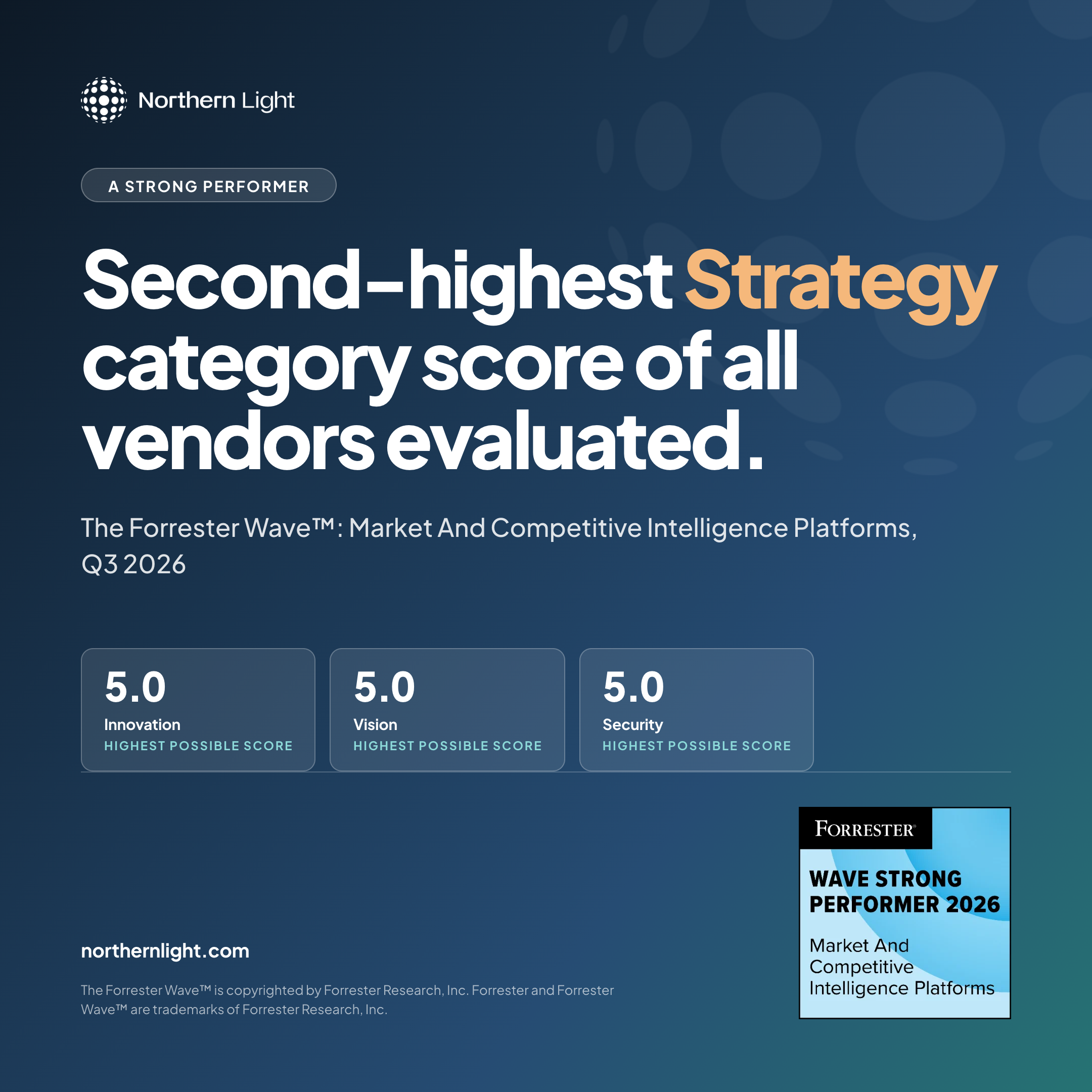
Northern Light SinglePoint is one platform in this category, describing itself as "one portal" spanning "internal reports, subscriptions, news, dashboards, and SME insights," where you "ask in your own words and get a cited answer, sourced to the page." It was named a Leader in the first-ever 2026 Gartner® Magic Quadrant™ for Competitive and Market Intelligence Platforms.
How should Copilot and an intelligence platform work together?
This is not an either-or, and framing it that way leads teams to the wrong decision. The two are strong in opposite places, so let each do the half it is built for. Keep Copilot for the inside: your documents, mail, meetings and drafting. Use a dedicated platform for the outside: licensed research, competitor monitoring, market questions that need a citation someone else can follow. Platforms in this category commonly integrate with SharePoint and other enterprise systems, so internal content does not have to be duplicated to be searchable alongside external sources.
The failure mode to avoid is treating any general assistant as the system of record for competitive facts. That is how an unverifiable claim ends up in a board deck. The same trap applies to consumer tools, covered in ChatGPT versus a dedicated competitive intelligence platform, and it is closely related to the governance question in what is bring your own AI.
Frequently asked questions
Can Microsoft Copilot do competitive intelligence?
Copilot can support competitive intelligence work that draws on your own organization's records: summarizing internal research, pulling themes from call notes, drafting a battlecard from material you supply. It is not sufficient for competitive intelligence on its own, because the underlying facts about competitors and markets live in licensed external sources outside your Microsoft 365 tenant, which Copilot has no entitlement to reach.
Can Copilot access Gartner, Forrester or other analyst research?
Not by default, but more than you might expect. Several publishers have built Copilot connectors: Forrester ships both a connector and an AI agent for customers with an active Forrester license, and connectors exist for IDC, Statista, S&P Global, PitchBook and PubMed among others. There is no Gartner connector in either of Microsoft's galleries. In every case you supply the subscription yourself, and Microsoft states that complying with the publisher's license terms is your responsibility.
Does Microsoft Copilot cite its sources?
Usually, with a documented caveat. Microsoft says that "where possible" responses based on business documents include references to their sources, and the same documentation warns that Copilot may include information not present in its input sources and asks users to be aware of the risk of overreliance. Granularity varies by source: Microsoft is rolling out deep citations that link into the relevant part of a tenant document, while citations over connector content remain links to the returned item rather than to the passage a claim came from.
Can Copilot read content outside Microsoft 365?
Yes, through Copilot connectors, in two ways: synced connectors index external content into Microsoft Graph, and federated connectors query an external system in real time via the Model Context Protocol. Both have licensing conditions. Indexing into Microsoft Search works on any Microsoft 365 plan, but grounding Copilot on that content requires the paid Copilot add-on, and federated connectors are available only with that add-on or Microsoft 365 E7.
Is building a Copilot Studio agent a good substitute for a market intelligence platform?
For narrow questions over content you already control, an agent can work well. For market and competitive questions it usually is not: Copilot Studio's public-web knowledge is a scoped Bing search over a limited set of domains and cannot reach content behind a paywall or login, an agent answers when asked rather than monitoring a market, and someone has to own the schema, licensing and citation plumbing indefinitely.
How much does Microsoft 365 Copilot cost?
Microsoft 365 Copilot is $30 per user per month paid yearly, or $31.50 paid monthly on an annual commitment. That is an add-on price: Microsoft states that "a separate license for a qualifying Microsoft 365 plan is required" underneath it, so the real per-seat cost is the Copilot add-on plus whichever Microsoft 365 plan you run. Budget separately for a subscription to each external publisher you want Copilot to be able to read.
The bottom line
Copilot answers a question worth answering: what does my own organization already know? For a great deal of daily knowledge work that is the right question, and Copilot answers it well.
Competitive intelligence asks a different question: what is happening outside my organization, how do I know, and can I prove it? That is answered by the content a tool is allowed to read and the provenance it can show, not by the model doing the reading. Connectors and agents narrow the gap at the cost of licensing dependencies and an integration project. The honest conclusion is that Copilot is a strong assistant for your inside and a thin one for your market.
Want the deeper technical case for why general enterprise AI falls short on grounded market research? Download Northern Light's technical whitepaper, The Architecture Behind Northern Light AI.
Sources: Microsoft, Data, privacy, and security for Microsoft 365 Copilot; Manage web search in Copilot; What is Microsoft 365 Copilot; Prerequisites for deploying Copilot connectors; Federated Copilot connectors overview; Microsoft-built connector gallery; Copilot connectors extensibility overview; Copilot extensibility known issues; Show citations with response semantics; Copilot connectors terms of use; Transparency note for Microsoft 365 Copilot; Copilot Studio knowledge sources; Copilot Studio requirements and quotas; Copilot Studio unstructured data; Copilot Studio pricing; Researcher FAQ; Microsoft 365 Copilot pricing. Forrester, Forrester AI Agent for Microsoft 365 Copilot. Australian Digital Transformation Agency, Microsoft 365 Copilot trial evaluation findings (trial conducted 2024).
Gartner and Magic Quadrant are registered trademarks and service marks of Gartner, Inc. and/or its affiliates in the U.S. and internationally and are used herein with permission. All rights reserved. Gartner does not endorse any vendor, product or service depicted in its research publications, and does not advise technology users to select only those vendors with the highest ratings or other designation.