About
LeadershipCareersBook a Live DemoA working guide to choosing a market and competitive intelligence platform. What a platform has to be able to read, the 3 jobs every platform does, who has to sign off, and 8 criteria worked in order.

We send the guide and occasional research updates. Unsubscribe anytime.
Why this matters now
What is inside
Which licensed databases, analyst firms and financial sources are included, which are billed separately, and what it takes to get a competitor transcript in every quarter without a person downloading it.
Unify, enrich, activate. Each is only as good as the one before it, which is why a demo that dazzles on the third tells you little about the first.
Search answers the question you thought to ask. Why most inherited keyword digests stop being read, and what monitoring has to do instead.
Licensed content breadth and depth, behavior when coverage is thin, and governance and AI use rights are pass or fail. A platform that fails any of them is out regardless of its total.
A look inside


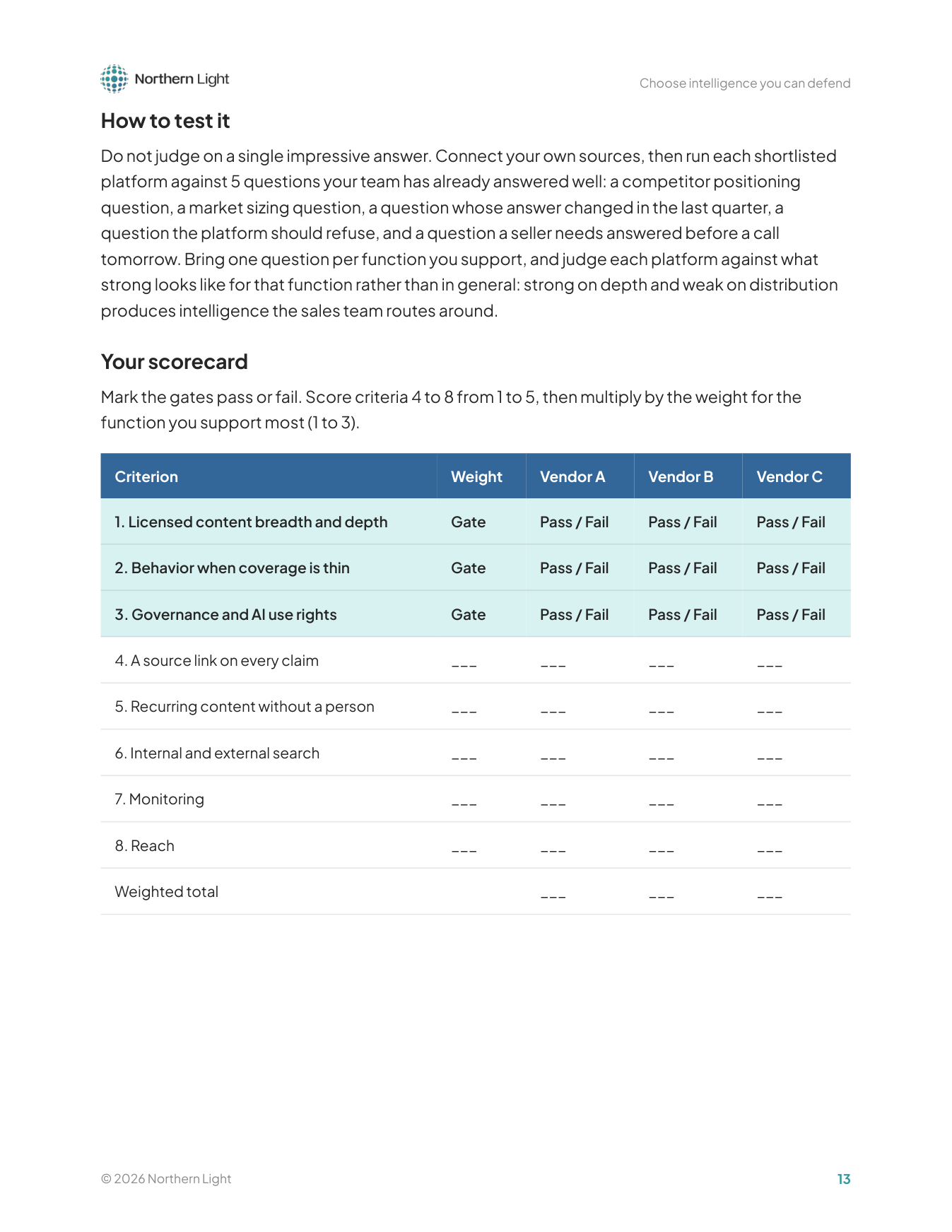
3 of the 8 are gates rather than scores: licensed content breadth and depth, what the platform does when coverage is thin, and governance and AI use rights. A platform that fails any of them is out regardless of its total, because none can be fixed after contract. The remaining 5 are scored 1 to 5 and weighted by the function you support most.
Unify, enrich, activate. Unify is one governed index across licensed, proprietary and internal content, with permissions that follow the content. Enrich is the search and retrieval beneath the AI, with a citation on every claim. Activate is delivery into the CRM, the digests and the assistants people already use. Each is only as good as the one before it, which is why a demo that dazzles on the third tells you little about the first.
Three. Ask what it takes to get a competitor earnings transcript into the platform every quarter, for every competitor: if the answer involves a person downloading and uploading it, you have found where the time goes. Give the platform a question you have already commissioned a study for, and compare the output to what you paid for. And pick a competitor move you found out about late, then ask the vendor to reconstruct what their platform would have done in that window, against your own sources.
For most teams the incumbent is not another vendor, it is manual assembly: a licensed database, a web search, a folder of prior research, a general AI tool, and somebody stitching them together under time pressure. The guide treats that as the baseline to beat, and the honest measure of a platform is how much of that person's week it gives back.
Four groups, each at the point where their question can still change the shortlist. The budget owner before the shortlist, on the workflow it replaces and what success looks like in year one. IT, security and AI governance at shortlist, on access, audit logging, retention and AI use rights. Procurement before final demos, on the pricing shape and what changes at renewal. The teams who will read the output, during demos, on how intelligence reaches the CRM, the field and the readers who will never hold a seat.
The question is rarely whether to replace them, it is which one is the hub. Sales-enablement competitive tools distribute a position well but do not produce the research behind it. Enterprise search connects internal systems with no licensed external content. Data and analytics platforms handle structured data and no unstructured external content. General AI assistants sit outside the category: useful for exploration, unable to reach licensed research or prove where an answer came from.