Shortlist pharma and biotech market and competitive intelligence platforms with 8 criteria, a demo checklist and the questions vendors struggle to answer: congress coverage and regulators beyond the FDA.
Instant PDF download. We'll also send occasional research updates; unsubscribe anytime.
What is inside
Breadth without depth is its own failure. A broad source set that has not been enriched for this industry is noise with good coverage, so a query about a mechanism of action has to return what a scientist means by it.
Most platforms are strongest on the FDA and thinner everywhere else. If your programs touch Brazil, China or Japan, name Anvisa, the NMPA and the PMDA, and ask what is covered today rather than what is planned.
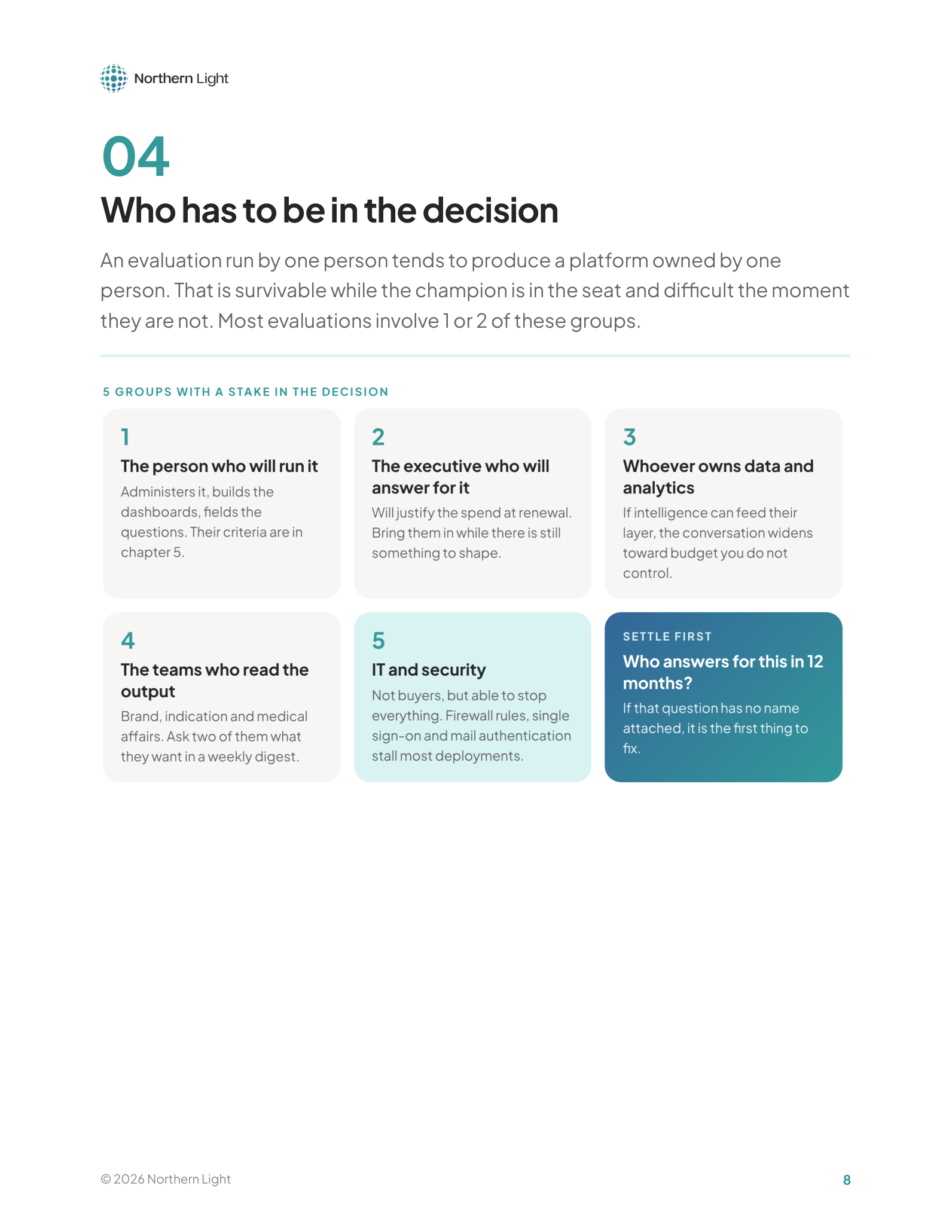
An evaluation run by one person tends to produce a platform owned by one person, which is survivable until they move on. The guide names the five groups with a stake and when to bring each one in.
Work them in order. The first three are pass or fail, and a platform that fails any of them is out regardless of its total, because none can be fixed after contract.
A look inside

“We were not short of information. We were short of one place to stand.”
Every platform in this category has AI now, and every vendor says grounded and traceable. What separates market and competitive intelligence platforms is the licensed research the AI can legally reach, what the platform does when the evidence is thin, and whether an answer arrives in time to change the decision it was asked about.
Most platforms are strongest on the FDA and thinner everywhere else. If your programs touch Brazil, China or Japan, name Anvisa, the NMPA and the PMDA in the evaluation and ask what is covered today rather than what is planned. A regulatory group that has to source its own content outside the platform will not use the platform.
Abstracts and posters are frequently the earliest public signal on a competitor program, and congress output is among the most heavily used material in pharma and biotech. Ask how many conferences are covered, how far back the archive runs, and what the process is when a congress you care about is not on the list.
Three of the eight are gates rather than scores: licensed content and scientific depth, what the platform does when coverage is thin, and governance and AI use rights. A platform that fails any of them is out regardless of its total, because none can be fixed after contract.
Five groups have a stake: the person who will run the platform, the executive who will answer for it at renewal, whoever owns data and analytics, the teams who will read the output, and IT and security. Most evaluations involve one or two of them, which is how a platform ends up owned by one person.