The 2026 Inflection Point: From Experimental Pilots to Integrated Strategy
AI has crossed the threshold from competitive advantage to baseline expectation, and strategy teams that haven't operationalized it are already falling behind.
The numbers make this hard to dispute. According to OpenAI's State of Enterprise AI report, 92% of Fortune 500 companies have adopted generative AI tools within their organizations. That statistic alone signals a fundamental shift: this is no longer an experiment. The question for 2026 isn't whether to use AI, it's which AI, and how deeply it's embedded in decision-making.
Then vs. Now: Two years ago, most enterprise AI lived in the shadows. Employees used consumer-grade tools quietly, outside IT governance, producing inconsistent outputs with no audit trail. Today, that "Shadow AI" era is closing. Enterprises are replacing ad hoc usage with governed platforms that integrate directly into strategic workflows, connecting to proprietary data, enforcing compliance guardrails, and producing traceable outputs. At Northern Light, we’ve watched this shift compress from a multi-year transition to a six-month strategic priority, and the teams adapting fastest share one trait: they treat AI as an operating layer, not a feature.
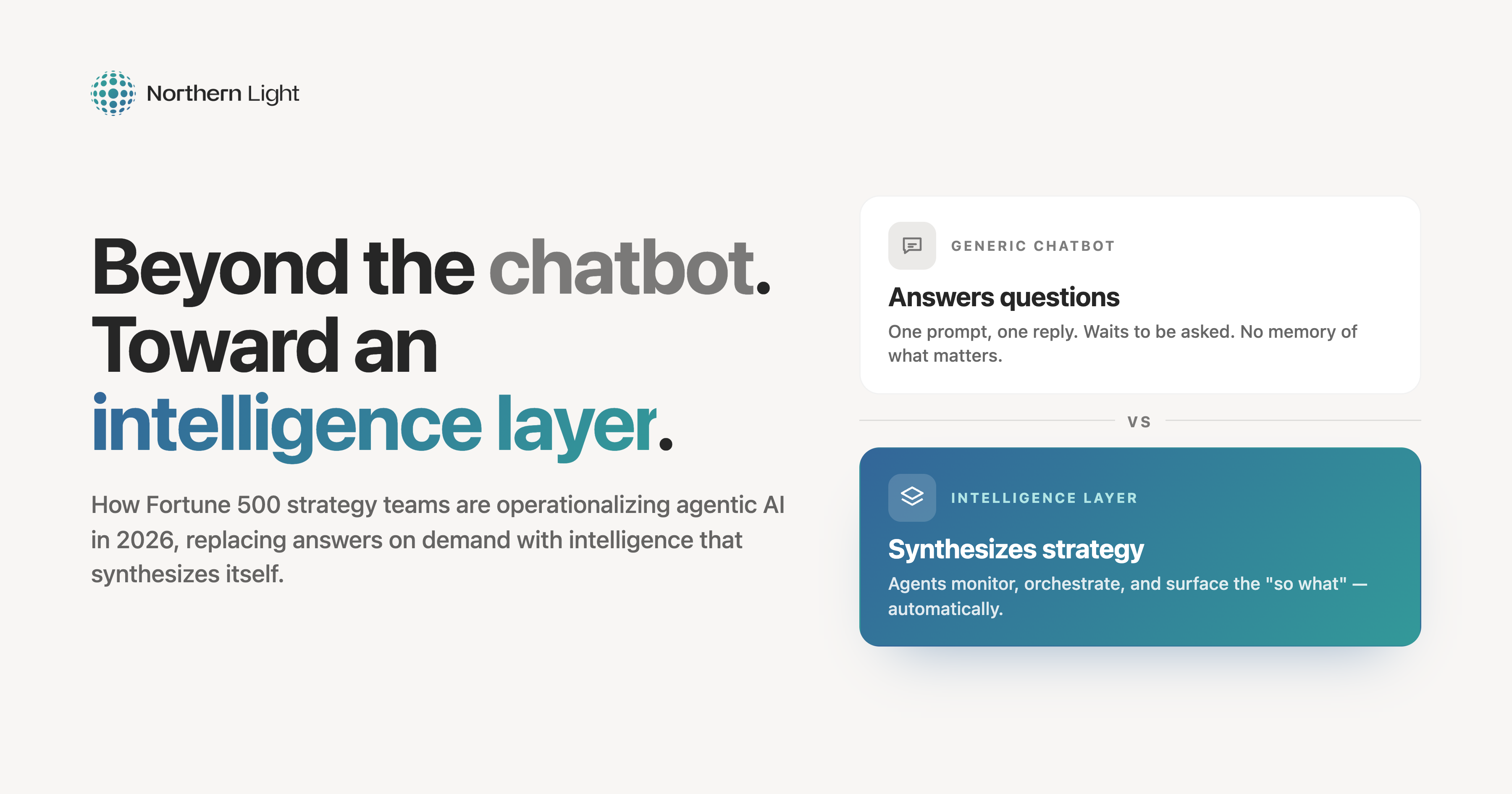
This distinction matters enormously. A generic chatbot answers questions. A Specialized Intelligence Layer synthesizes competitive signals, regulatory filings, and market intelligence into actionable strategy, automatically. Whether it's enterprise intelligence platforms reshaping IT decision-making or generative AI in financial services driving real-time scenario planning, the same pattern holds: depth beats breadth.
Nowhere is this more visible than in life sciences, where the volume, velocity, and complexity of competitive data is pushing teams toward fully automated intelligence synthesis.
Life Sciences: Automating the Synthesis of Complexity
Life sciences strategy teams face a data problem unlike any other industry, and in 2026, multi-agent AI is becoming the primary answer.
Understanding what is the role of AI agents in market research 2026 is nowhere more consequential than in pharma and biotech, where a missed signal in a competitor's drug pipeline can cost hundreds of millions in misdirected R&D investment. According to the Deloitte Life Sciences Industry Outlook, strategy teams are now deploying multi-agent systems to automate the synthesis of clinical trial results and regulatory updates, work that once consumed entire analyst teams.
The competitive landscape in life sciences no longer moves at human reading speed. ClinicalTrials.gov updates daily. Patent filings appear in real time. Regulatory agency communications arrive in bursts. Manual tracking isn't just inefficient, it's structurally incapable of keeping pace.
What agentic systems change is the synthesis layer. Rather than collecting data, agents now do the following in parallel:
In practice, this moves strategy teams away from the question "what happened?" toward the far more valuable question "what does this mean for us?" That shift, from manual data gathering to agentic synthesis, is redefining the competitive intelligence function entirely.
One practical pattern emerging across large pharma organizations is a tiered agent architecture: specialized sub-agents handle domain-specific feeds (clinical, patent, regulatory), while an orchestrating agent synthesizes findings into a unified competitive landscape brief, updated on a defined cadence.
The complexity of life sciences data makes it one of the clearest proving grounds for agentic AI. The same dynamics, high volume, high stakes, high regulation, apply with equal force to financial services, where the pressure to compress insight cycles is just as intense.
Financial Services: Reducing the 'Time to Insight' for Board-Level Decisions
Financial services strategy teams are achieving something that once seemed impossible, compressing weeks of market analysis into hours, without sacrificing the depth that board-level decisions demand.
The core bottleneck has always been data aggregation. Earnings call transcripts, Federal Reserve commentary, yield curve shifts, competitor filings, assembling and synthesizing these inputs traditionally required entire analyst teams working in parallel. In 2026, multi-agent systems are automating that collection layer entirely, pulling from structured and unstructured sources simultaneously and surfacing synthesized signals rather than raw data dumps.
The impact on reporting cycles is measurable. Financial services firms report a 40% reduction in the time required to produce quarterly "State of the Market" reports, according to Accenture's Banking Strategy Report. That compression isn't just an efficiency win, it changes the strategic rhythm of the organization. Insights that previously arrived after a decision window had closed now arrive before it opens.
The workflow transformation is most visible when you map traditional processes against agent-augmented ones:
Traditional Workflow → Agent-Augmented Workflow
- Analysts manually pull earnings transcripts → Agents ingest and tag transcripts in real time
- Macro data consolidated across siloed tools → Unified data layer updated continuously
- Report drafting takes 2–3 weeks → Draft synthesis generated in hours
- Strategy team reviews raw findings → Team evaluates interpreted, prioritized insights
- Board deck built from static snapshots → Narrative built from living intelligence feeds
The role shift this creates is arguably more significant than the time savings. Strategy professionals who spent 60–70% of their time gathering and formatting data are now operating as high-level advisors, stress-testing assumptions, challenging AI-generated conclusions, and translating intelligence into decisions. This mirrors a pattern observed across sectors; notably, similar dynamics are reshaping how teams work in adjacent industries, including the acceleration of generative AI in life sciences research workflows.
Understanding how these agent systems actually orchestrate that work, and what separates genuine agentic architecture from a well-dressed prompt chain, is the critical question for teams evaluating their own intelligence operating model. That's precisely what the next section unpacks.
The Role of AI Agents in Market Research 2026
Agentic AI represents the most fundamental shift in how strategy teams gather and synthesize intelligence, moving from passive tools that answer questions to autonomous systems that pursue answers independently.
The core distinction is this: simple prompting retrieves information; agentic orchestration generates insight.
To understand the architecture, think of it in three layers:
An autonomous AI unit assigned a discrete research task, such as monitoring competitor pricing signals or scanning regulatory filings. It acts, evaluates results, and iterates without constant human instruction.
The coordinating layer that assigns tasks across multiple agents, manages dependencies, resolves conflicts between findings, and assembles outputs into a coherent deliverable. This is where complexity is absorbed so humans don't have to carry it.
The living intelligence infrastructure that agents draw from and write back to. Unlike a static knowledge base, this layer continuously ingests new sources, deprecates outdated signals, and maintains structured context across every query.
This three-layer pattern is exactly what Northern Light's SinglePoint AI is built around: a content foundation, a multi-agent orchestration engine, and proactive delivery into the tools strategy teams already use, including Microsoft Copilot and any LLM connected via MCP. McKinsey's State of AI Trust in 2026: Shifting to the Agentic Era frames this transition explicitly: enterprises are moving from experimental AI toward governed autonomous systems that take on responsibility once held by dedicated analyst teams. In practice, that shift looks like agents indexing, governing, and activating thousands of intelligence sources simultaneously, a scale no human team could replicate manually.
This architecture directly eliminates what Northern Light calls the DIY burden: the hidden cost of researchers spending hours curating sources, chasing down data, and stitching together fragmented reports. The shift from static repositories to dynamic intelligence layers is where the real productivity gain lives, and it's the structural advantage Forrester cited when naming Northern Light a Leader in The Forrester Wave: Market and Competitive Intelligence Platforms.
Among the most advanced ai use cases in life sciences, financial services, and manufacturing, this three-layer model is becoming the standard deployment pattern. However, understanding the architecture is only half the equation, putting it into production at enterprise scale is where most organizations still struggle, a challenge the next section addresses directly.
Operationalizing AI at Scale: Solving the 85% Failure Rate
Most AI initiatives stall not because the technology fails, but because organizations underestimate what it takes to move from promising pilots to enterprise-wide execution. According to NTT Global research, only 15% of organizations are successfully turning AI vision into operational reality, a sobering reminder that strategy without infrastructure is just aspiration.
The gap between AI ambition and AI outcomes is almost always an operational problem, not a technology problem.
Building the four pillars below is what separates that 15% from everyone else:
⚠️
When business units maintain separate, incompatible data environments, AI agents produce fragmented, unreliable intelligence, undermining the very decisions they were meant to sharpen. Consolidation isn't optional; it's foundational.
Understanding how search and discovery work together inside a unified platform clarifies why architecture matters so much before agents are ever deployed. With these pillars in place, the conversation shifts from "can we make AI work?" to something far more consequential, making it the strategic backbone of the entire organization.
Conclusion: Building the Backbone of 2026 Strategy
Operationalizing artificial intelligence at scale is no longer a technical milestone, it's the defining strategic mandate for every Fortune 500 insights leader in 2026. As CFOs acknowledge, AI is driving transformation, not just efficiency. The question isn't whether to act, it's whether your infrastructure can support the ambition.
The teams winning in 2026 aren't using more AI tools, they're using fewer, better-connected ones. Fragmented point solutions create the exact chaos that agentic AI is meant to eliminate. A centralized intelligence OS removes the DIY burden, giving research and insights teams a single environment where agents can plan, execute, and synthesize without constant human handholding.
Before moving forward, validate your readiness against this Strategic Mandate checklist:
The path from AI pilot to enterprise intelligence backbone is navigable, but only with the right foundation beneath it. Explore how Northern Light SinglePoint™, the Competitive & Market Intelligence Platform for the AI Era, gives strategy teams the operating model they need to lead in 2026.