

Multi-Agent AI for Automated Market Research and Intelligence Synthesis
What Is Multi-Agent AI for Market Research?
Multi-agent AI for market research refers to an architecture where networks of specialized AI agents collaborate to divide complex research tasks. These AI agents work in parallel to synthesize findings into structured, actionable intelligence, replacing traditional manual analyst workflows that are often slow, inconsistent, and challenging to scale.
Market research involves a constant race against time, and until recently, enterprises struggled to keep pace. Analyst teams manually aggregated competitive signals, licensed databases they couldn't fully utilize, and produced intelligence reports that were outdated before reaching executives. Multi-agent AI transforms this process entirely.
Multi-agent systems utilize coordinated agents to divide labor, execute tasks in parallel, and pass verified outputs through an orchestration layer. This method enables enterprises to capitalize on automated, AI-driven market analysis at scale, contributing to the projected $42 billion growth in the AI agents market by 2029.
"Organizations require more than AI models; they need robust infrastructure, compliance frameworks, and dedicated teams for genuine enterprise intelligence."
Most organizations possess access to large language models, but often lack the necessary 150+ individually licensed research contracts, SOC 2-certified infrastructure, copyright compliance frameworks, and a dedicated maintenance team. This differentiation sets genuine enterprise intelligence platforms apart from general-purpose AI tools repurposed for research.
How Does Multi-Agent AI Work in Automated Market Research?
A multi-agent AI system assigns distinct roles to specialized agents, each optimized for specific functions such as data retrieval, entity extraction, synthesis, or validation. This mirrors expert research team operations, where one agent retrieves data, another validates it, a third synthesizes findings, and a fourth formats the deliverable.
Microsoft's analysis of multi-agent systems highlights orchestration, specialization, and collaboration as three pillars distinguishing true multi-agent architectures from simple chained prompts. Each agent maintains its own context, tools, and decision logic while contributing to a shared intelligence outcome.
"Deep AI was leveraged to integrate clinical evidence, competitive intelligence, and emerging external signals across literature, pipelines, news, and key conference readouts, enabling a robust, objective assessment of a new entrant's claim of competitive advantage."
- Director, Market Research
The 9-Agent Research Pipeline
Inside Northern Light SinglePoint, this architecture is implemented as Deep Research, a SinglePoint AI application that runs a 9-agent autonomous research pipeline directly on the platform's governed content. The pipeline executes in sequence:
Interview Agent: Clarifies research objectives, scope, timeframe, and priorities.
Planning Agent: Develops a transparent research plan before execution begins.
Query Agent: Generates optimized Boolean and semantic queries, refined iteratively.
Search Agent: Executes queries across the full governed, licensed content stack.
Summarization Agent: Synthesizes findings from complete documents, not chunks.
Relevance Judge Agent: Validates retrieved content for accuracy and quality.
Coverage Judge Agent: Evaluates completeness; loops back to the Query Agent if gaps remain.
Ranking Agent: Prioritizes findings by relevance and authority.
Report Agent: Produces a fully cited, audit-ready report.
Deep Research replaces hours or days of manual searching and document stitching with a single guided workflow inside SinglePoint that delivers decision-grade intelligence.
Example Deep Research output: 247 documents read · 98% coverage · 53 citations · 6-minute runtime. Every claim traceable to a governed, licensed source.
What Are the Key Benefits of Multi-Agent AI in Market Research?
Multi-agent AI provides advantages that accumulate across the research lifecycle, offering more than just time savings in automated market research.
Throughput at scale. A coordinated multi-agent system can produce multiple synthesis-ready intelligence briefs in parallel, outperforming human analyst teams that might complete one competitive landscape report per week.
Decision latency. AI-powered research workflows dynamically adapt to research goals, enabling enterprises to respond to market signals in hours rather than weeks. Forum Ventures' research indicates autonomous AI agent workflows are rapidly becoming the standard for enterprise intelligence operations.
"Deep Research delivered speed and efficiency gains by eliminating the need for additional primary research, accelerating strategic decision-making while reducing cost by $250,000."
- Associate Director, Market Research
Consistency. Agent-driven processes apply uniform analytical frameworks across every source, eliminating the variability inherent in manual analyst workflows.
Auditability. Each agent's output is independently logged and reviewed. Enterprise deployments prioritize source traceability, which ranks as the top driver of platform trust and adoption, as every finding links to a specific, licensed source document.
Scalability. Coverage expands without proportional increases in headcount or licensing overhead.
What Makes Enterprise Multi-Agent AI Different from General-Purpose AI?
Enterprises often overlook the critical distinctions between general-purpose AI tools and specialized enterprise platforms.
1. Content No One Else Can Access
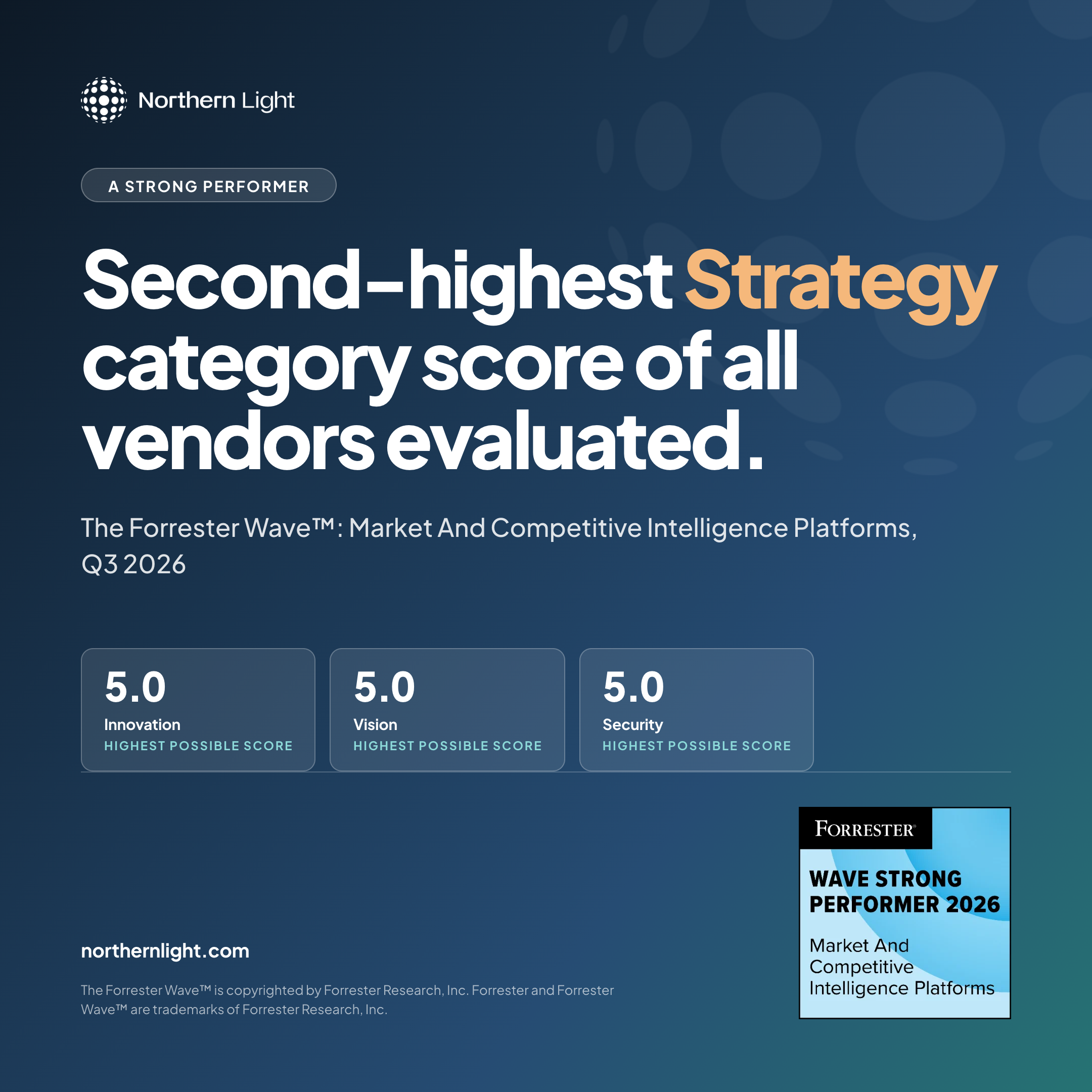
Northern Light was recognized as a Leader in The Forrester Wave: Market and Competitive Intelligence Platforms, in part because of this content moat. Northern Light SinglePoint operates on a restricted dataset, inaccessible to open-web AI tools:
150+ individually licensed syndicated research providers covering market research, competitive intelligence, financial analysis, and industry analysis.
4,000 vetted CI and market intelligence news sources delivering 30,000 curated stories daily, free from open-web noise.
6M+ global patent records with legal status and expiration data across 105+ countries.
1M+ corporate financial reports, including SEC filings and ESG disclosures.
5M+ life sciences conference abstracts and scientific articles.
This content is legally off-limits to tools like Microsoft Copilot, Claude, and ChatGPT when accessed directly. Northern Light has AI use rights negotiated with every provider. Through SinglePoint AI's MCP server, that governed intelligence becomes queryable from inside Microsoft Copilot, Claude, and ChatGPT itself, giving teams Q&A access to the same content moat without leaving the AI tool they already use. For deeper, multi-agent research workflows, Deep Research runs the full nine-agent pipeline directly inside SinglePoint, on the same governed content. Two paths, one source of truth.
"I don't even go ask these questions in ChatGPT or Copilot. Knowing I can specifically select only the life sciences collection, that's why I use Deep Research."
- R&D Insights Manager, Global CPG
2. Full-Document AI: No Chunking
Most AI tools use standard Retrieval-Augmented Generation (RAG), breaking documents into small fragments, leading to context loss. Northern Light processes the entire document, preserving cross-document context.
This approach was validated when a life sciences research team asked about biologic hesitancy rates across Latin American markets. Deep Research synthesized data from multiple countries using a 200-page study, a feat not possible with standard RAG implementations.
3. Coverage Validation Before Output
Northern Light's Coverage Judge agent checks for completeness before generating a report, ensuring trustworthiness. General-purpose AI tools lack this coverage validation step, making gaps invisible until errors arise.
How Do Enterprises Implement Multi-Agent AI for Market Research?
Implementing multi-agent AI requires more than just choosing a platform. Enterprises face unique architectural and governance challenges.
Data integration is crucial, as multi-agent systems draw value from diverse sources, including licensed research databases and public signals. Clean data pipelines are essential for reliable outputs.
Governance is equally vital. Enterprises should define human-in-the-loop checkpoints for high-stakes intelligence outputs. Multi-agent AI workflows with structured review stages produce more trustworthy deliverables than fully autonomous pipelines.
Security and access control demand attention. Enterprise-grade platforms ensure:
Zero data retention: Research queries and outputs are not stored or used for model training.
SOC 2-certified infrastructure: Built-in enterprise security.
Copyright compliance at every layer: Maintained as provider terms evolve.
Governance documentation: Ready for legal and IT review.
The result: rapid deployment, with no need for LLM fine-tuning or compliance framework development.
What Are Real-World Use Cases for Multi-Agent AI in Market Research?
Pharmaceutical Competitive Intelligence
Pharmaceutical companies can deploy agents to scan clinical trial filings and patent databases, monitor analyst commentary, and synthesize regulatory signals, delivering a structured intelligence brief within hours.
Supply Chain and Commodity Monitoring
Global manufacturing firms can track raw material pricing trends using specialized agents to monitor commodity exchanges and supplier communications, providing consolidated reports with flagged anomalies.
Enterprise-Scale Competitive Intelligence
Enterprise intelligence teams use governed AI platforms to continuously update competitive intelligence across business units, leveraging agentic research, licensed content, and purpose-built CI workflow tools.
What Are the Limitations of Multi-Agent AI for Market Research?
Responsible deployment requires acknowledging constraints. Multi-agent AI does not eliminate market intelligence complexity; it redistributes it.
Data quality is foundational. Agents synthesize only accessible information, with gaps surfacing in outputs where licensed data coverage or internal repositories are lacking.
Governance and accuracy require oversight. Automated synthesis may produce subtly incorrect conclusions, especially with contradictory sources. Enterprises should establish review checkpoints and confidence thresholds.
Additional considerations include:
Integration complexity: Connecting agents to legacy systems requires IT investment.
Regulatory exposure: Varying jurisdictional accountability for automated decision-making.
Model hallucination risk: Large language models can fabricate citations; full-document AI with traceable citations mitigates this risk but does not eliminate it.
Common Misconceptions About Multi-Agent AI
"It's just a faster chatbot." Multi-agent systems plan, delegate, verify, and synthesize, managing workflows across multiple data sources, differentiating them architecturally from simple chatbots.
"AI replaces the research team." Multi-agent platforms handle data-gathering, allowing analysts to focus on strategic interpretation. The platform conducts research; analysts interpret the findings.
"It works out of the box." Governed, enterprise-grade deployment requires configuration, source curation, and oversight. Enterprises recognize that raw AI capability without structured architecture yields inconsistent results.
"We can build it internally." Internal builds require extensive content licenses, content tagging, AI processing, infrastructure certification, and ongoing management. We call this the DIY burden: the compounding cost of researchers and engineers stitching together infrastructure that Northern Light SinglePoint already provides at scale.
Key Takeaways
Multi-agent AI is no longer a proof-of-concept; it represents a fundamental shift in automated market research capabilities, delivering scale, consistency, and reduced latency.
Orchestration outperforms single-model performance. Specialized agents, validated by a Coverage Judge, excel in complex intelligence tasks.
Content layer differentiates. An LLM accessing 150+ licensed research providers yields superior intelligence compared to open-web models.
Full-document AI prevents context loss that standard chunking introduces, enhancing output quality.
Governance and oversight are essential. Source traceability and compliance features make platforms defensible in enterprise reviews.
The AI agents market is rapidly growing, projected to expand by $42 billion through 2029, making platform selection a crucial strategic decision.
Multi-agent AI for market research offers a competitive edge for organizations investing in enterprise-grade intelligence platforms with governed content, promising compounded advantages over time. Explore how Northern Light SinglePoint, the Competitive & Market Intelligence Platform for the AI Era, serves strategic teams across functions to see what a governed, AI-native research architecture looks like in practice.